Alumna striving for a more inclusive world through artificial intelligence
Posted: 2 December 2025
Growing up in Khyber Pakhtunkhwa province, Pakistan, Australia Awards alumna Zarqa Khan was raised in an environment of cultural conservatism, gender inequality, and limited educational opportunities for women and girls. Despite these obstacles, she completed a bachelor’s degree from a public university in Peshawar and overcame further challenges to enter the workforce.
Zarqa was working with the non-government organisation Sarhad Rural Support Programme in her province’s tribal region when she first learnt about Australia Awards Scholarships through her professional circle. For her, this was more than a scholarship opportunity: it was a chance to fulfil her dream of shaping a more inclusive world, where everyone is treated fairly, irrespective of their gender, race, ethnicity or special needs. She wanted to make the lives of young girls and women easier by helping create a society without systemic inequalities, economic exclusion or gender-based discrimination.
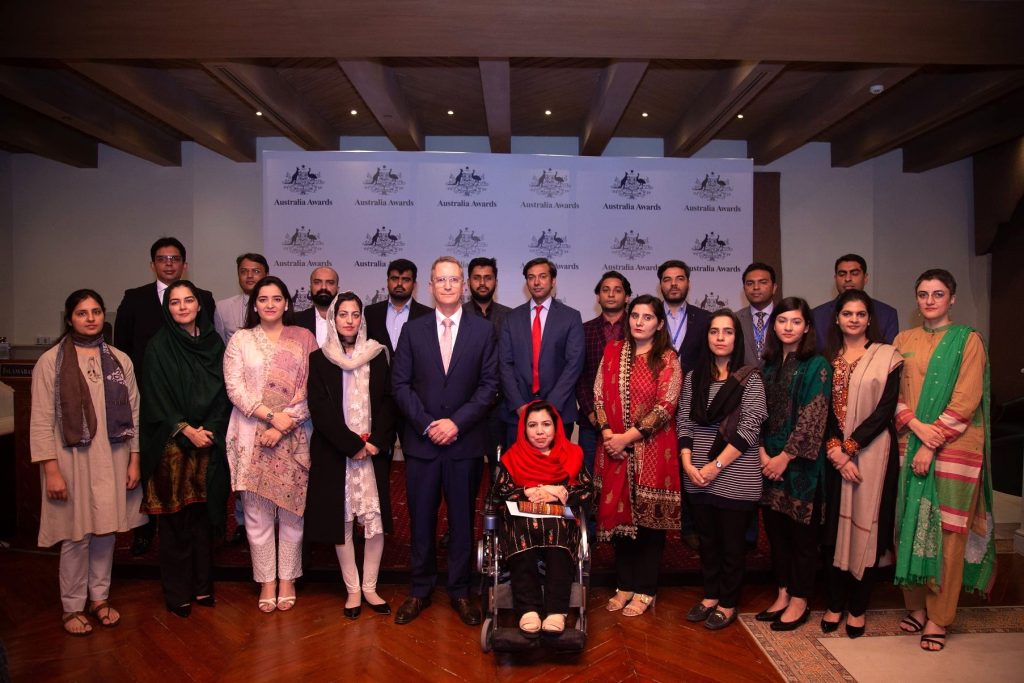
Zarqa (front row, third from right) with fellow Scholarship recipients from Pakistan and then Australian High Commissioner to Pakistan, Geoffrey Shaw, (middle in pale pink tie) at a farewell event in Islamabad 2019.
With the support of an Australia Awards Scholarship, Zarqa completed a Master of Development Studies (Gender and Development) at the University of Melbourne in 2021. “Studying at the University of Melbourne was transformative,” says Zarqa when she recalls her two-year journey in Australia. “The academic environment strengthened my critical thinking, research skills and understanding of global development frameworks.” It was not just the academic study that reshaped her world perspective, but also the multicultural and inclusive society in Australia, which helped her make lifelong friendships across the globe and made her truly value diversity and inclusion.
When Zarqa returned to Pakistan, she knew exactly what she needed to do to fulfil her dream of a genuinely inclusive society. “My passion was reinforced by the realisation that empowering women has a multiplier effect on families, communities and national development,” she says. She joined a program directly linked to women’s economic empowerment at UN Women, where she has had the opportunity to work on providing rural women amputees with prosthetic limbs powered by artificial intelligence (AI)—a first in Pakistan. Most of these women lost their limbs in accidents while working as agricultural labourers in rural Pakistan, after which society considered them worthless.
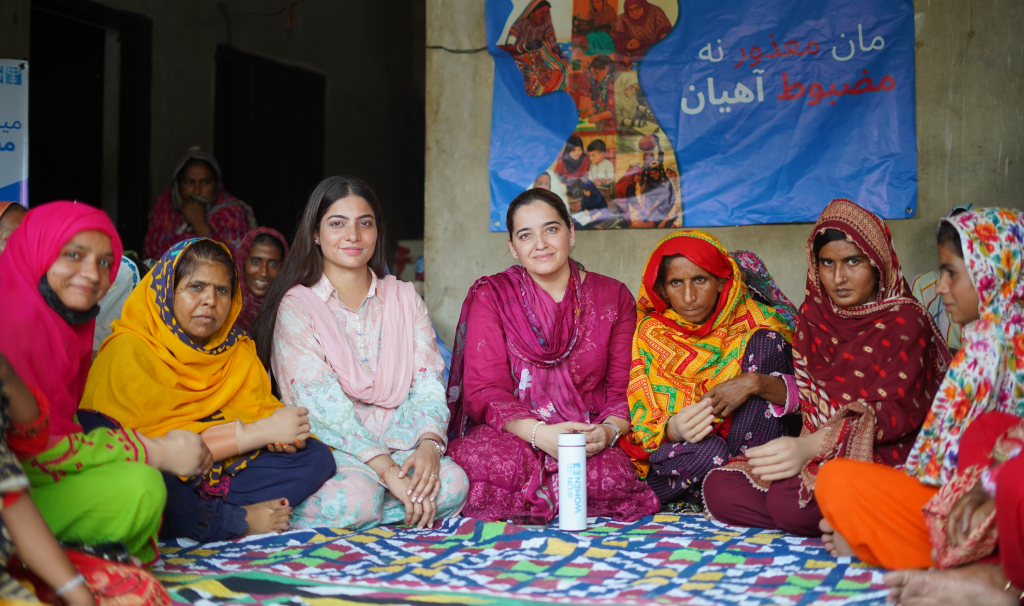
Zarqa (middle) with a colleague (third from left) pictured with women in Sindh Province who’ve received 3D-printed prosthetic arms through her AI project at UN Women in Pakistan.
The program, which began in May 2025, is currently being piloted in interior Sindh. It not only provides these women with sensor-based, 3D-printed prosthetic arms designed for agriculture and home-based work, but is also working to offer a holistic pre- and post-support model. The support mechanism includes rehabilitation, psychological counselling, and vocational and digital skills training. So far, five women with disability have received and benefited from AI-powered prosthetics under this project, and this is only the beginning.
This impactful work led to Zarqa receiving global recognition, including being nominated for the United Nations Secretary-General Awards 2025 under the Inclusion of Persons with Disabilities category.
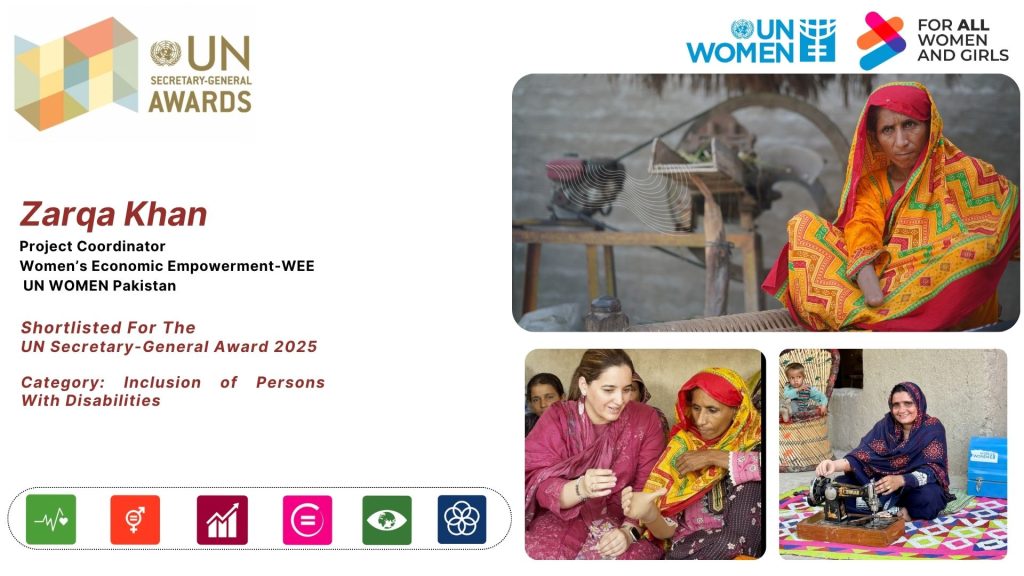
An image released as part of Zarqa being nominated for the United Nations Secretary-General Awards 2025.
Zarqa wants to further contribute by engaging more effectively with the government and providing her input to bring about policy change to strengthen the implementation of laws and policies for women with disability. As she strengthens her commitment, she says, “My long-term vision is to scale inclusive technology solutions for marginalised women across Pakistan and the Asia-Pacific region.”
Zarqa credits her Australia Awards experience for this achievement and advises professionals who intend to apply for an Australia Awards Scholarship to be clear about their development purpose, demonstrate passion, highlight leadership and, most importantly, believe in themselves. Australia Awards, she says, is not just an ordinary postgraduate scholarship; it is a transformative and life-changing leadership journey.