Alumnus transforming rural livelihoods in the tribal hills of Pakistan
Posted: 4 August 2026
Muhammad Riaz Khan was born, raised and educated until high school in the Tribal District of Bajaur, in the erstwhile Federally Administered Tribal Areas of Pakistan’s Khyber Pakhtunkhwa province. This region borders with Afghanistan and is one of the most underdeveloped areas of Pakistan. Riaz’s childhood was not easy. His primary school had no buildings, and students took classes under the shade of trees. His father was a labourer, and Riaz lost his mother when he was 10 years old. He walked to middle school, which was several kilometres away from his home. To get to his high school, he travelled more than 10 km using the very poor public transport available at the time in Bajaur.
Riaz says, “My childhood and early adulthood were spent entirely in tribal and village settings.” He recalls his limited awareness of Australia at that time: “For me, Australia was just a country with a good cricket team, and where Pakistan won the Cricket World Cup in 1992.”
Riaz began his career after completing his Doctor of Veterinary Sciences in Pakistan. While working in an organisation where most of his managers were Australians, he was impressed by their work ethic and knowledge. One of his friends introduced him to the Australia Awards Scholarship, and Riaz applied. After he was accepted, he began a post-graduate degree in Animal Sciences at Charles Sturt University in 2011.
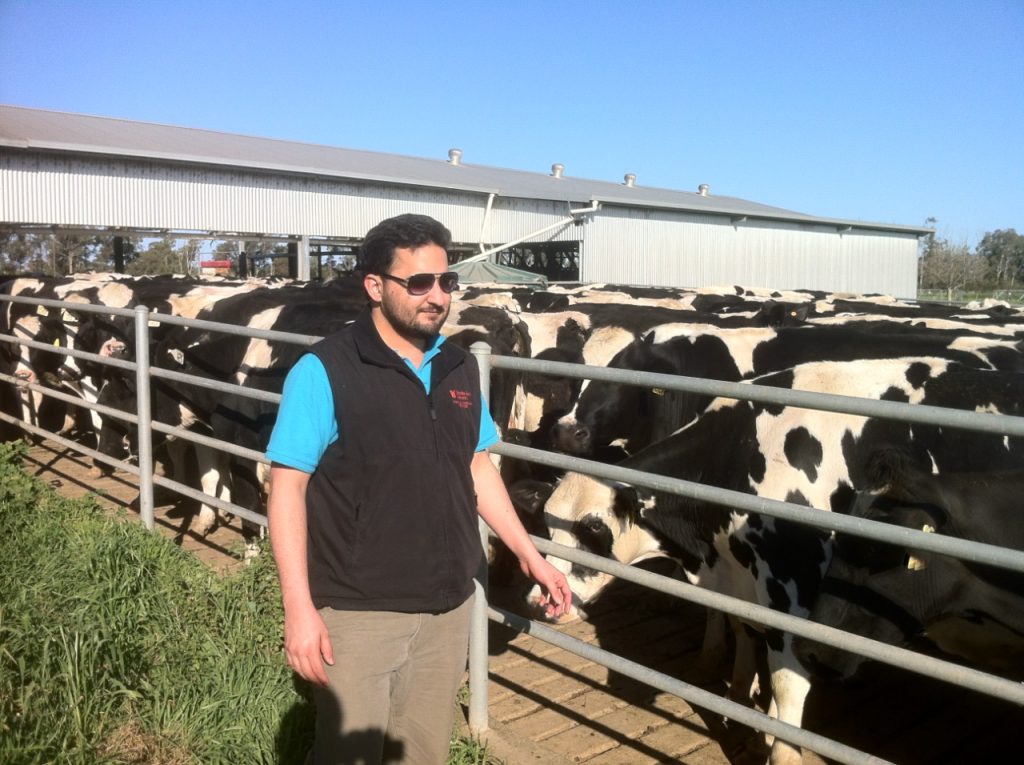
Riaz visiting a local dairy farm in Australia during his Australia Awards Scholarship.
Riaz’s Australia Awards journey was transformative in many ways. “My experience in Australia was great,” he says. His initial impressions were immediately positive, driven by people’s welcoming behaviour towards international students wherever he went, from university classrooms to his hostel. “They were very accommodative, they were aware of the language barrier, [and] the help we needed … was readily available,” he says.
His stay in Australia was full of pleasant surprises. He learnt new skills in class, experienced religious and cultural harmony, and observed Australia’s multicultural and multi-religious society, which made him realise how important these concepts are for a society to prosper. Riaz also worked in Australia during his studies to help his family back home.
Riaz returned to Pakistan in 2013 and started working on small dairy farms in Okara and Kasur Districts in Punjab. There, he conceived a project to lighten the workload of farming women in Bajaur by introducing them to technology commonly used in Australian cattle herds. This project was selected from among 2,700 proposals to receive a $100,000 Grand Challenges Explorations grant, an initiative funded by the Bill & Melinda Gates Foundation. The project trained women’s groups from isolated mountain villages in bovine reproductive management, benefiting women’s economic empowerment in livestock-related businesses. He turned this opportunity into further research by establishing linkages between his alma maters Charles Sturt University in Australia, the University of Veterinary and Animal Sciences in Lahore and the University of Agriculture, Peshawar.
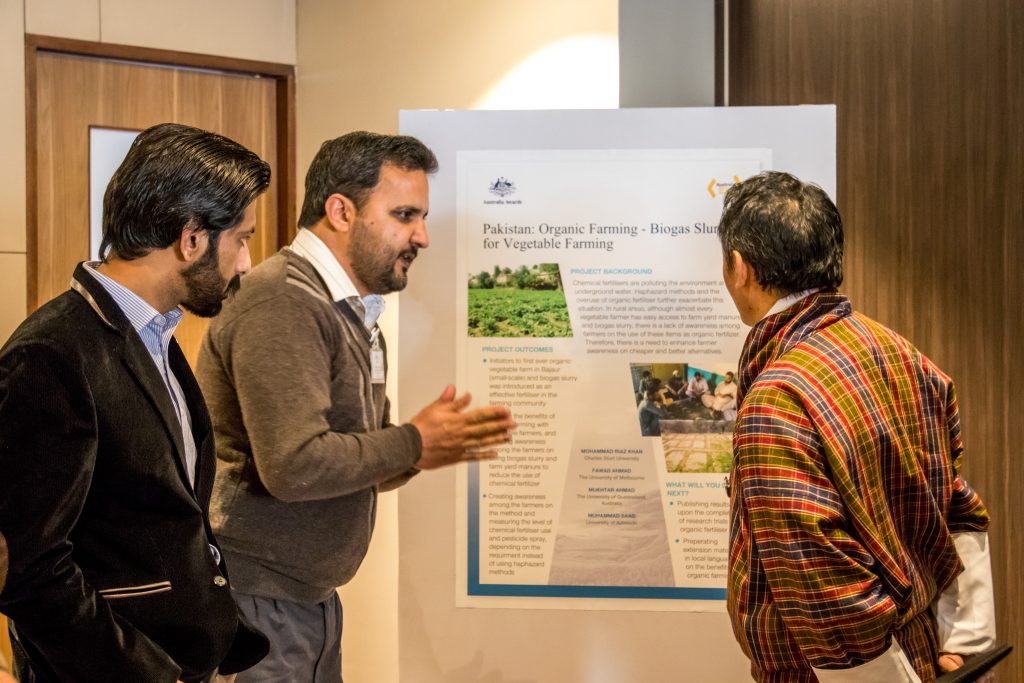
Riaz (second from left) presenting his work to Dasho Karma Tshiteem (right), a distinguished public servant in Bhutan, during the 2018 Regional Alumni Workshop in Thimphu.
He also received an Australia Awards Alumni Small Grant of AUD5,000 for his work on alternative energy sources. This grant was linked with women’s labour and health issues due to the use of hard fuel (wood). Through this grant, Riaz introduced concrete biogas plants in tribal areas for the first time. The Livestock and Dairy Development Department adopted this idea and constructed more than 200 biogas plants. Based on this work, the Government of Khyber Pakhtunkhwa proposed a project costing PKR400 million in the Annual Development Program 2026–27.
In 2016, the Australian High Commission awarded Riaz the Alumni Excellence award, recognising his remarkable contributions to the development of his country following his Australia Awards Scholarship. He also received another regional grant from Australia Awards for his work on using biogas slurry as organic fertiliser. In 2018, Riaz presented the resulting findings (titled ‘Alumni as champions of climate change’) at the Regional Alumni Workshop held in Bhutan.
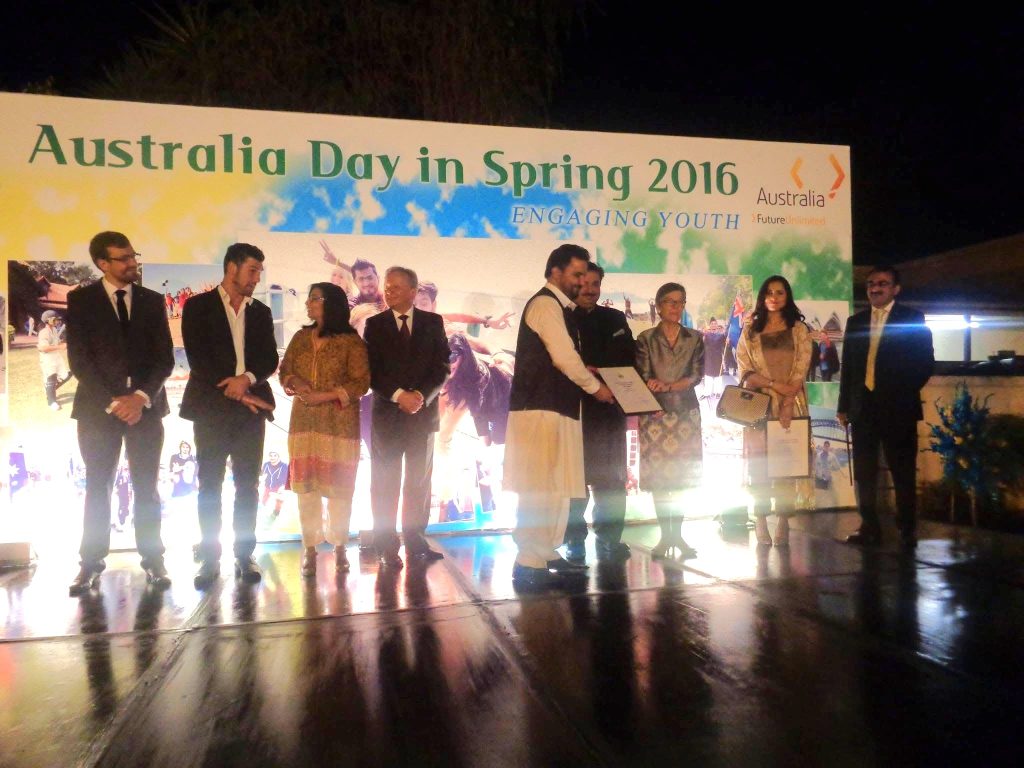
Riaz (middle, holding the certificate plaque) receiving the Alumni Excellence award in 2016.
Riaz is currently serving as Veterinary Officer in the Livestock and Dairy Development Department with the Government of Khyber Pakhtunkhwa. Motivated by the benefits his studies have had for his country and his career, he intends to pursue a PhD in the future.
“[An] Australia Awards Scholarship is a lifetime experience,” Riaz says to aspiring applicants. “The Scholarship provides opportunities for polishing one’s skills and exploring new ideas. Learn various cultures and explore the beauty of Australia.”
Recalling that he got this opportunity even though he belonged to one of the most underdeveloped areas of Pakistan, Riaz concludes, “[The] Australia Awards Scholarship selection process is tough but fair.”