

From one hill to another: How inclusion changed my life—and my mission
Posted: 31 August 2026
This year marks the 75th anniversary of Australian Government scholarships for students from the Asia-Pacific region, with the first scholarship recipients travelling to Australia under the Colombo Plan in 1951. To commemorate this significant milestone, Australia Awards – South Asia & Mongolia launched the Alumni Impact Storytelling Competition to celebrate the outstanding contributions alumni have made to the development of their countries.
The competition invited alumni to showcase the impact they have created and reflect on how their Australia Awards experience has helped shape their personal and professional journeys.
Pakistani alumna Saira Ayub’s entry was highly commended for its powerful reflection on how accessibility and inclusion can transform lives. Through a deeply personal account of her experience as an Australia Awards scholar with a disability, she described how experiencing an accessible environment in Australia reshaped her confidence, independence and sense of possibility. Judges highlighted the clear connection she drew between her own journey and her ongoing efforts to advance inclusive education, disability awareness and accessibility in Pakistan.
Saira completed a Master of Education at Flinders University in South Australia in 2021.
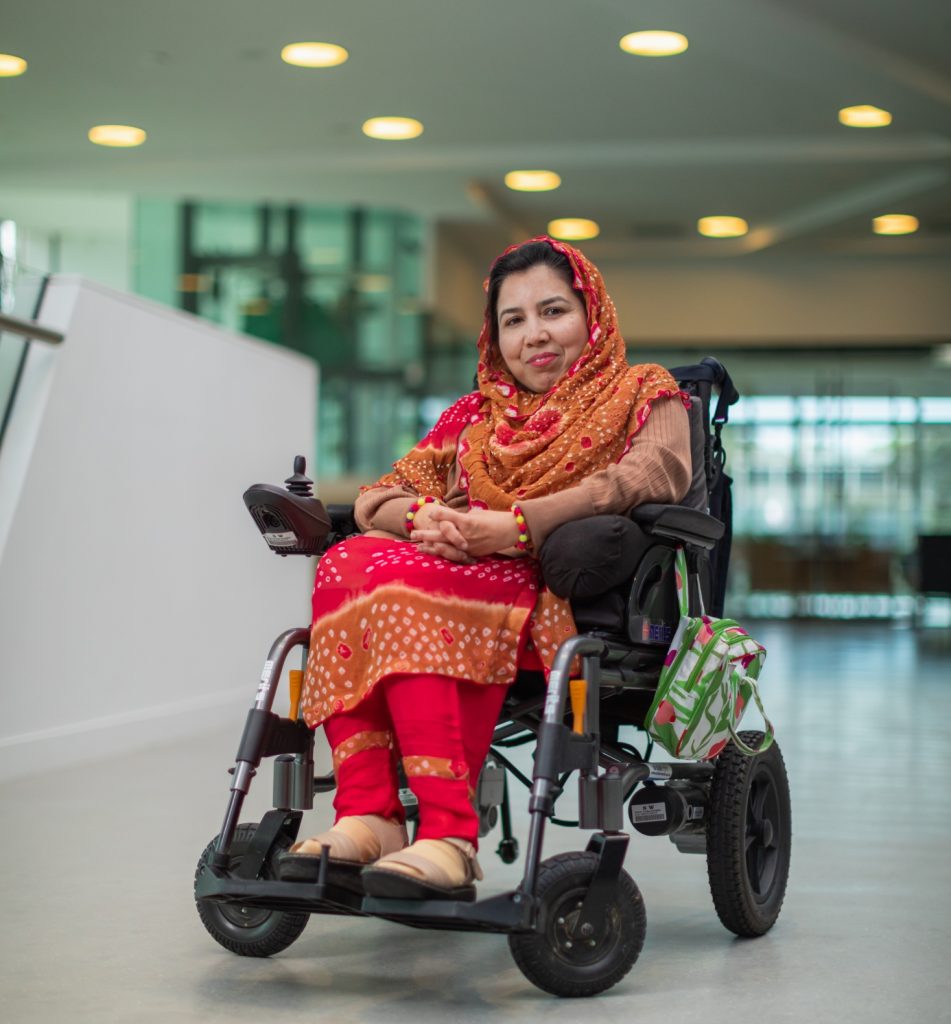
Saira photographed at Flinders University.
My first independent trip from one hill to another at Flinders University is still fresh in my memory. As a wheelchair-bound person, I felt exhilarated at the independence I experienced for the first time in my life. That day, something shifted inside me.
I arrived in South Australia in January 2020 as an Australia Awards scholar, carrying a mix of self-doubt and excitement. When I found out that the university campus was spread across hills, I quietly wondered to myself: “Would I really be able to move here independently?”
In Pakistan, throughout my life, movement had always required planning, support and caution. At Flinders University, a member of the university’s disability support team guided me along accessible pathways from my accommodation to my department. She showed me ramps, lifts, alternate routes and safe entrances that I could use independently. Later that day, I travelled nearly six kilometres across campus on my own without encountering stairs, barriers or broken pathways.
For the first time in my life, movement felt effortless. As I crossed the beautiful white bridge that connected one hill of the university to another, I paused for a moment. On both sides, I could see stretches of green landscape and, in the distance, the calm beauty of Brighton Beach. The sound of Australian birds filled the air, and the pathway ahead of me felt smooth, open and welcoming—designed not as an obstacle, but as an invitation. In that moment, I felt as if my disability had reduced by eighty percent. That journey from one hill to another became more than a physical journey. It became a journey from hesitation to confidence, from dependence to independence, and from limitation to possibility.
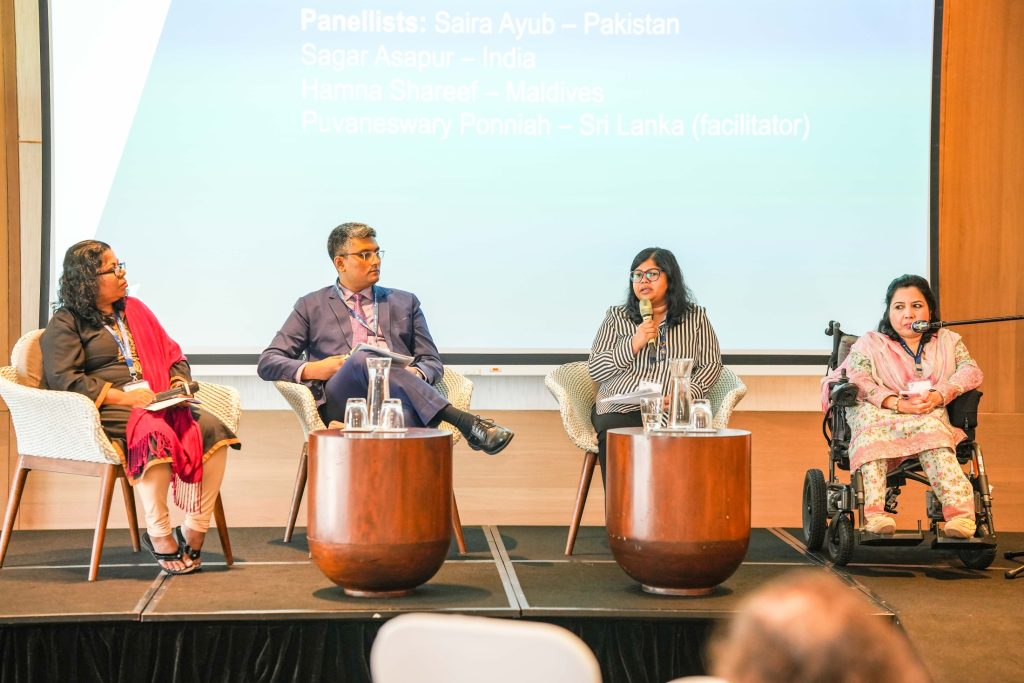
In 2025, Saira (right) participated as a panellist addressing inclusivity at the Australia Awards Regional Alumni Workshop held in Sri Lanka.
Growing up in Pakistan with muscular dystrophy, I completed my education in mainstream educational institutions that were not designed for students with disabilities. In my home country, the physical challenges are entangled with the social and attitudinal barriers that are even harder to handle. Since my childhood, I had witnessed people doubting my ability to continue my education or build a professional career. Even when I began my career as a lecturer, I continuously suffered from self-doubt. Would I be able to continue this job for more than six months with my disability? This was the question that kept bothering me. Yet I remained determined. My students who saw me as an inspiration became my biggest driving force.
I wanted to reach out to more people, so I began writing articles and stories, especially focusing on women with disabilities, who often face double discrimination. The barriers I faced made me realise that these were not caused by the physical conditions alone, but by the absence of inclusive planning in infrastructure, education systems and public services. This understanding strengthened my belief that real change would only come through awareness, advocacy and policy-level reform that ensures equal opportunities for everyone.
During my interview for the Australia Awards Scholarship, I made one commitment: if I were given the opportunity to experience accessibility in a developed country, I would return and share what I learnt to help improve inclusion in Pakistan.
Australia gave me that opportunity.
Even before I arrived at Flinders University, I noticed something different. The Australia Awards team carefully asked about my daily routines, mobility needs, accommodation arrangements and assistive requirements. For the first time in my life, I felt that I was not being seen only as a person with a disability—but as a differently abled human being.
At Flinders University, I studied a Master of Education in Leadership and Management, where I explored inclusive education practices that ensure equal learning opportunities for all students. But what transformed me most was not only what I studied—it was what I experienced. Transport, buildings and public places were accessible for my wheels. I travelled independently and explored places I had previously only imagined visiting.
Accessibility changed how I moved. It also changed how I saw myself.

Saira (middle) working as Assistant Professor of Economics at the Government Graduate College for Women (Gulberg) in Lahore, Pakistan.
During my time in Australia, I also served in leadership roles in international student with disabilities initiatives. Through our discussions, I realised that many developing countries share similar accessibility challenges—and that change requires collaboration across borders. Australia did not just teach me theories of inclusion. It allowed me to live inclusion.
While I was studying in Australia, I experienced one of the most difficult moments of my life when I lost my sister and brother in a tragic accident. That period was filled with grief and trauma. Yet during that time, I received extraordinary support from my university, fellow international students and the Australia Awards community. Their compassion reminded me that inclusion is not only about infrastructure—it is also about human connection.
I returned to Pakistan with a renewed sense of purpose. One of my first goals was to improve accessibility within my own institution. With the support of my college administration, I helped guide the construction of ramps according to international standards. Since then, I have conducted teacher-training sessions across multiple colleges to share inclusive education practices that I learnt in Australia. As provincial coordinator of the National Forum of Women with Disabilities, I have attended workshops and awareness sessions in collaboration with United Nations organisations and government departments working on disability inclusion, legislation, health access and education policy. I also participated in the 2025 Australia Awards Regional Alumni Workshop in Colombo, Sri Lanka. Through these efforts, I have learnt something important: Disability does not exist only in the body. It exists in the environment around us—and when environments change, lives change.
The journey that began on the hills of Flinders University is still continuing. It is now my life’s mission to focus on promoting inclusive education in mainstream institutions so that every student—regardless of any disability—can participate fully in learning. I continue to collaborate with educators, policymakers and disability organisations to strengthen awareness, improve accessibility infrastructure and support the development of inclusive policies aligned with Sustainable Development Goal 4: “Ensure inclusive and equitable quality education and promote lifelong learning opportunities for all”. I know there is still a long way to go before accessibility becomes a standard part of educational institutions across Pakistan. But with every ramp that is built, every teacher who chooses inclusion and every student who discovers their potential in an accessible classroom, I see the future coming closer—a future where no dream is stopped by a staircase.