

Alumna championing circular solutions for water and waste in Pakistan
Posted: 20 November 2026
This year marks the 75th anniversary of Australian Government scholarships for students from the Asia-Pacific region, with the first scholarship recipients travelling to Australia under the Colombo Plan in 1951. To commemorate this significant milestone, Australia Awards – South Asia & Mongolia launched the Alumni Impact Storytelling Competition to celebrate the outstanding contributions alumni have made to the development of their countries.
The competition invited alumni to showcase the impact they have created and reflect on how their Australia Awards experience has helped shape their personal and professional journeys.
Pakistani alumna Dr Mehr Nigar’s entry (below) placed in the ‘Commended’ category of the competition for its reflective account of finding purpose at the intersection of engineering and sustainability. Dr Nigar completed an Australia Awards Short Course on Supporting Water Security, Resilience and Transitioning to Circular Cities in Pakistan in 2025. Her story stood out for describing how exposure to circular economy principles and water resource recovery systems in Australia challenged her existing assumptions and inspired new ways of thinking about wastewater, energy and resource use. Judges particularly appreciated the way the submission traced the journey from personal transformation to practical influence, showing how lessons from the Short Course are now informing teaching, research and sustainability-focused thinking in Pakistan.
Before my Australia Awards experience, I often felt out of place in my professional environment. In many ways, I was a square peg in a round hole. Trained as a chemist with a PhD in polymer science and engineering from Case Western Reserve University in the United States, I returned to Pakistan and was confronted with the harsh reality of plastic waste damaging the pristine landscapes my country is known for. This ignited in me a deep commitment to sustainability—one that grew into an inner calling that was impossible to ignore.
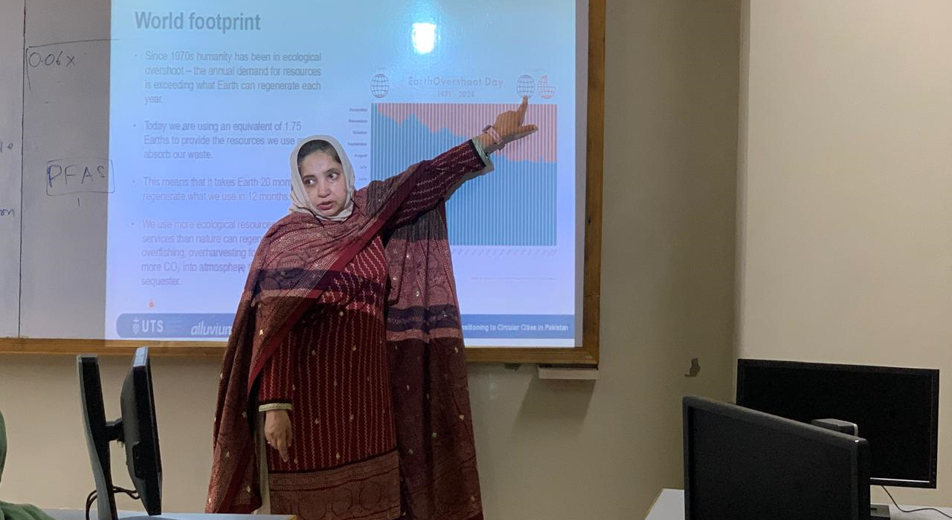
Making the invisible visible: Dr Nigar explaining ecological overshoot and highlighting how everyday choices can help shape Pakistan’s collective future.
However, my professional setting did not reflect this passion. Due to family commitments, I was teaching freshman chemistry and engineering materials in the Mechanical & Aerospace Engineering department at Air University, Islamabad—an environment focused on machines, engines and structures. Sustainability and green engineering were rarely central to conversations.
Despite this, I persisted. I tried to integrate sustainability into my courses and discussions, but these efforts often remained on the margins—lacking the depth needed to drive meaningful change. Over time, this created a quiet but persistent sense of intellectual isolation, where the work I cared most deeply about struggled to find its place within mainstream engineering practice.
Being selected for the Australia Awards Short Course on Supporting Water Security, Resilience and Transitioning to Circular Cities in Pakistan became the catalyst that changed everything.
Having lived with this sense of being an intellectual misfit for years, I initially struggled with imposter syndrome. When I was selected, excitement quickly gave way to doubt. I questioned whether I even belonged in this space. My background was not in water systems, and the course seemed heavily focused on water. At one point, I seriously considered not attending.
A conversation with a trusted colleague shifted my thinking. He simply said, “You will find your space once you get there.” That was enough. I decided to go.
What I encountered in Australia transformed my perspective.
At University of Technology Sydney’s Institute for Sustainable Futures, I began to see water not as a separate domain, but as part of a broader circular system—one that urbanisation had disrupted by turning naturally circular flows into linear ones. I realised that wastewater, if managed intelligently, could address some of the most pressing challenges faced by Pakistani cities, particularly water and energy scarcity.
I also saw how Australian cities are proactively planning for this—through water-sensitive urban design, reuse systems and resource recovery. Even everyday practices challenged my assumptions. The idea that tap water is safe to drink, and that rainwater harvesting contributes to urban systems, felt almost unreal coming from a context where groundwater depletion is an escalating crisis. For someone deeply connected to nature, this was more than technical knowledge—it was a powerful demonstration of what is possible when systems are designed in harmony with natural cycles.
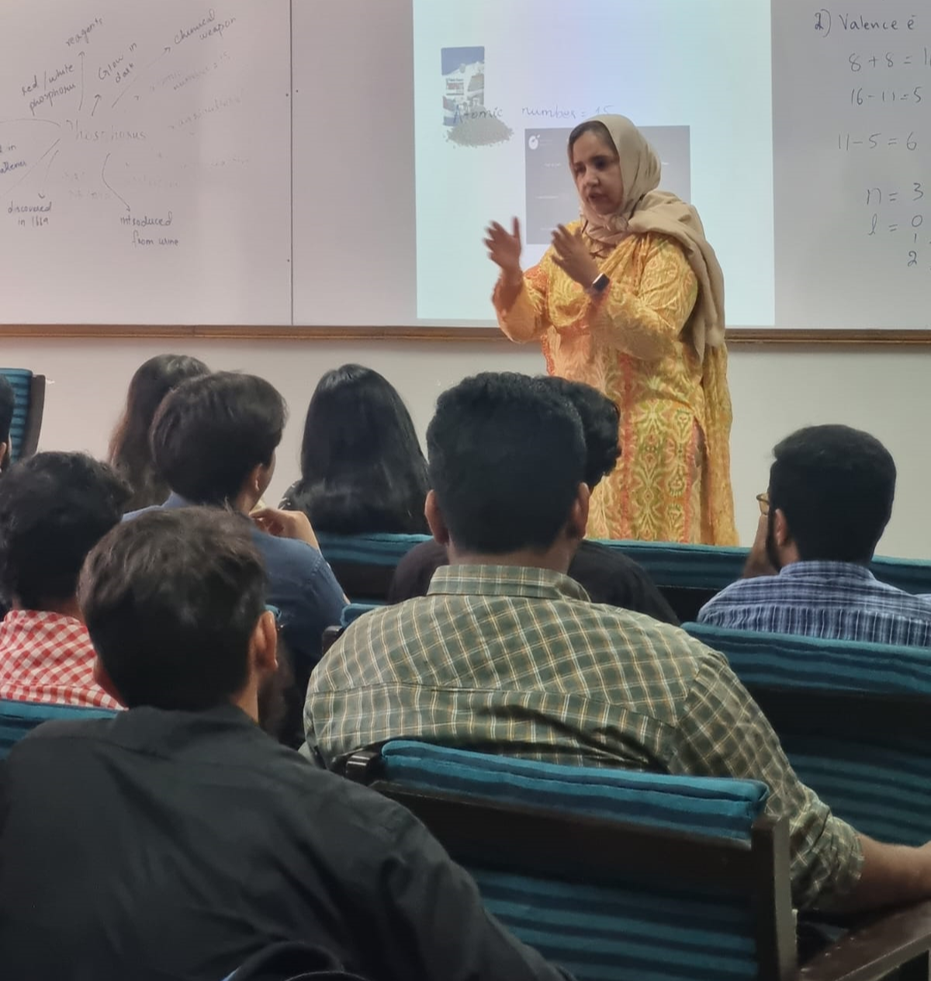
Engaging and inspiring students: Dr Nigar encouraging the next generation of engineers in Pakistan to think critically, act responsibly and become agents of sustainable change.
One of the most defining moments of my learning journey was visiting wastewater treatment and resource recovery facilities in Sydney and Melbourne. Prior to this, I was familiar with greywater recycling and had encouraged my students to explore similar ideas. However, what I witnessed went far beyond that.
Here, wastewater—including sewerage—was treated not as waste, but as a valuable resource. Nutrients were recovered and converted into bio-fertilisers, treated water was reused and, most strikingly, energy was generated at a remarkable scale. At one facility, the energy produced was sufficient to power the entire plant, with excess fed back into the grid.
This was more than a technical insight—it was a complete paradigm shift.
Seeing these systems in action made the concept of water resource recovery tangible and undeniable. It transformed sustainability from an abstract idea into an engineered reality, even revealing gaps in my own understanding.
When I brought these insights back to my classroom, the impact was immediate. For my students and colleagues, the idea that wastewater could generate energy was genuinely eye-opening. It reframed sustainability from an abstract concern into a field of engineering opportunity.
In one lecture, I introduced a simple but provocative example—a bottle of plant fertiliser derived from human urine. What initially triggered disbelief quickly turned into curiosity. For many students, it was the first time they considered that even something perceived as waste could hold value if approached through the right systems. That moment captured a fundamental shift: sustainability is not just about managing waste, but about redefining it.
This transformation has reshaped how I teach, engage and collaborate. I now embed real-world examples into my courses, helping students connect theory with lived systems. Concepts such as circular water systems, wastewater valorisation and resource efficiency are no longer abstract—they are actionable.
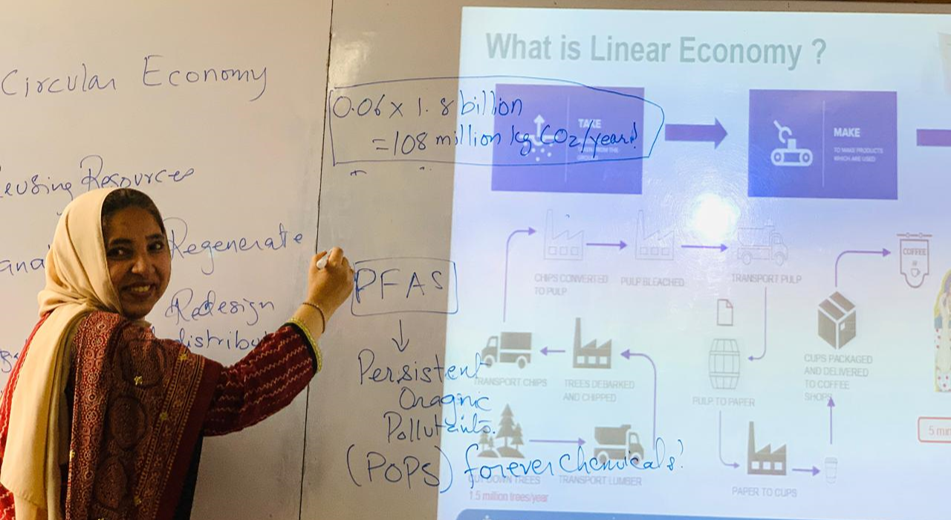
Introducing circular economy thinking: From linear to circular, Dr Nigar teaching resource efficiency, the value of waste as a resource, and the principles of a circular economy.
Beyond the classroom, this shift has begun translating into research and collaboration. It has contributed to the development of a proposal focused on wastewater resource recovery through biodigester systems. More importantly, it has sparked interdisciplinary conversations within my department: colleagues are now exploring how emerging technologies can be integrated into sustainable systems. For the first time, there is a sense of synergy. I no longer feel like an outsider—I belong in the room.
Equally significant has been the shift in perspective among my peers. Sustainability is no longer seen as peripheral but is gradually gaining recognition as an integral part of engineering practice. What was once an individual effort is slowly becoming a shared direction.
Today, I feel a renewed sense of alignment in my work. The Australia Awards experience did not just expand my knowledge—it connected me to a community, a way of thinking and a sense of purpose.
Moving forward, I am committed to strengthening sustainability-focused education and research within my sphere of influence, particularly in advancing water resource recovery systems in Pakistan. In a country facing increasing water stress and resource constraints, reimagining wastewater as a source of energy, nutrients and clean water is not just an innovation—it is an urgent necessity.
This journey has transformed how I see engineering—not as a discipline that simply manages resources, but as one that has the potential to redefine them.