

How an Australian education reshaped my work across borders
Posted: 6 October 2026
This year marks the 75th anniversary of Australian Government scholarships for students from the Asia-Pacific region, with the first scholarship recipients travelling to Australia under the Colombo Plan in 1951. To commemorate this significant milestone, Australia Awards – South Asia & Mongolia launched the Alumni Impact Storytelling Competition to celebrate the outstanding contributions alumni have made to the development of their countries.
The competition invited alumni to showcase the impact they have created and reflect on how their Australia Awards experience has helped shape their personal and professional journeys.
Alumna Umme Kulsoom’s entry was highly commended for demonstrating how Australia Awards can amplify the impact of experienced development practitioners. Umme completed a Master of Development Studies at the University of Melbourne in 2023.
Her story showed how Australian study helped her evolve from a skilled practitioner into a strategic advisor, applying global perspectives and evidence-based approaches to advance gender equality, governance and social inclusioninitiatives across Pakistan and beyond. Judges highlighted the tangible examples she provided of translating learning from Australia into measurable professional impact at national, regional and international levels.
In 2019, I sat across from a young woman in a government shelter in Khyber Pakhtunkhwa. She had fled domestic violence, walked for two days, and arrived at a facility with no case management system, no referral pathway and staff who had never been trained in survivor-centred care. I was working as Ending Violence Against Women and Governance Adviser at UN Women Pakistan at the time. I knew the system was failing her. But I did not yet have the analytical tools to explain exactly why, or to design something better at a structural level.
That moment stayed with me.
By then, I had already spent over a decade working on gender equality, protection and governance across Pakistan. I had managed programs, trained police officers, drafted standard operating procedures and run emergency education responses in displacement camps for crisis-affected children. I understood the practice deeply. What I lacked was the theoretical and comparative framework to connect what I was seeing on the ground to the global evidence on what actually works, and to position myself in international policy conversations with confidence.
The Australia Awards Scholarship changed that trajectory.
When I arrived at the University of Melbourne in 2022 to pursue a Master of Development Studies with a specialisation in Gender and Development, I carried with me 13 years of field notebooks, workshop reports and unanswered questions. Melbourne gave me the space and the rigour to work through those questions properly. I studied comparative policy analysis, intersectional methodologies and evidence-based approaches to social change. For the first time, I could place my Pakistan experience within a global framework.
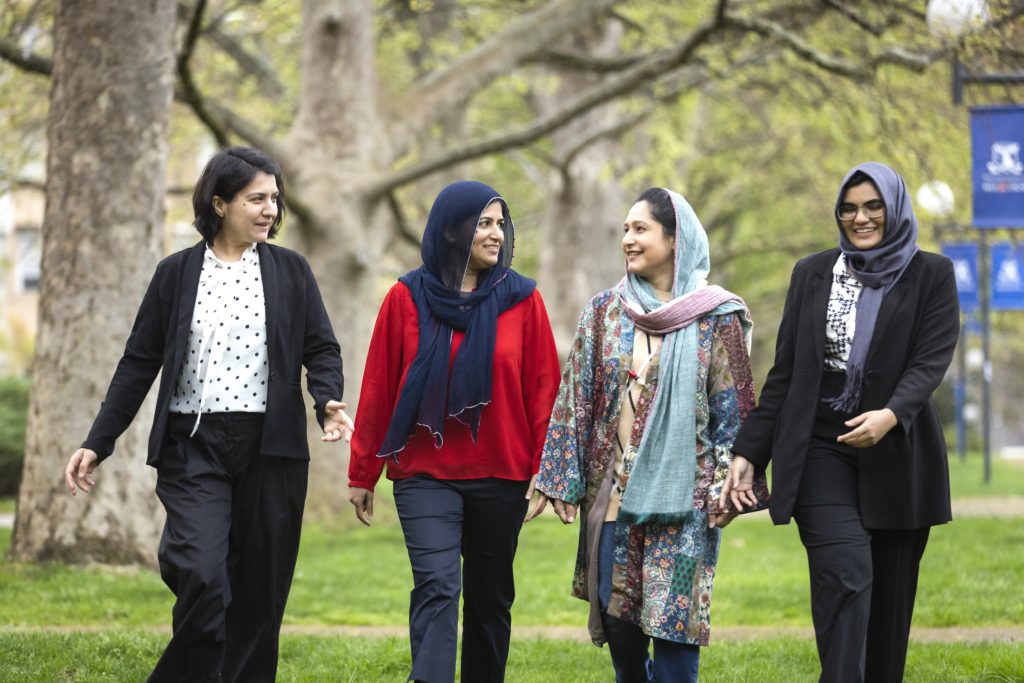
Umme (second from right) pictured with other female scholars from Pakistan in Melbourne during her Scholarship experience in Australia.
I examined what worked in Latin America’s conditional cash transfers, what fell short in South Asia’s shelter systems and why Scandinavian gender mainstreaming models could not simply be transplanted into post-conflict Pashtun communities.
Beyond the classroom, Melbourne gave me something equally important: exposure to Australian gender equality thinking in practice. I worked with the Australian Gender Equality Council, where I helped redraft their manifesto on women’s political participation and developed a workplace gender equality policy framework.
That experience of working within an Australian institutional setting on gender strategy reshaped how I approach strategy development today. I learnt to think in terms of systems, not just programs.
The impact since returning home has been specific and measurable.
Within months of completing my degree, the United Nations Educational, Scientific and Cultural Organization (UNESCO) Regional Office in Italy engaged me as an International Expert to lead a multi-country gender analysis across Albania, Bosnia, Croatia and Montenegro. I designed the research methodology, coordinated national gender experts in four Western Balkan countries and produced a regional gender analysis report that fed directly into the DIKTAS II project’s mid-term evaluation. This was not a role I could have secured, or performed at this level, before Melbourne. The ability to hold multiple country contexts simultaneously, synthesise diverse data sources into one coherent framework and communicate findings to European institutional audiences: these are capabilities I built in Australian classrooms and sharpened through Australian research culture.
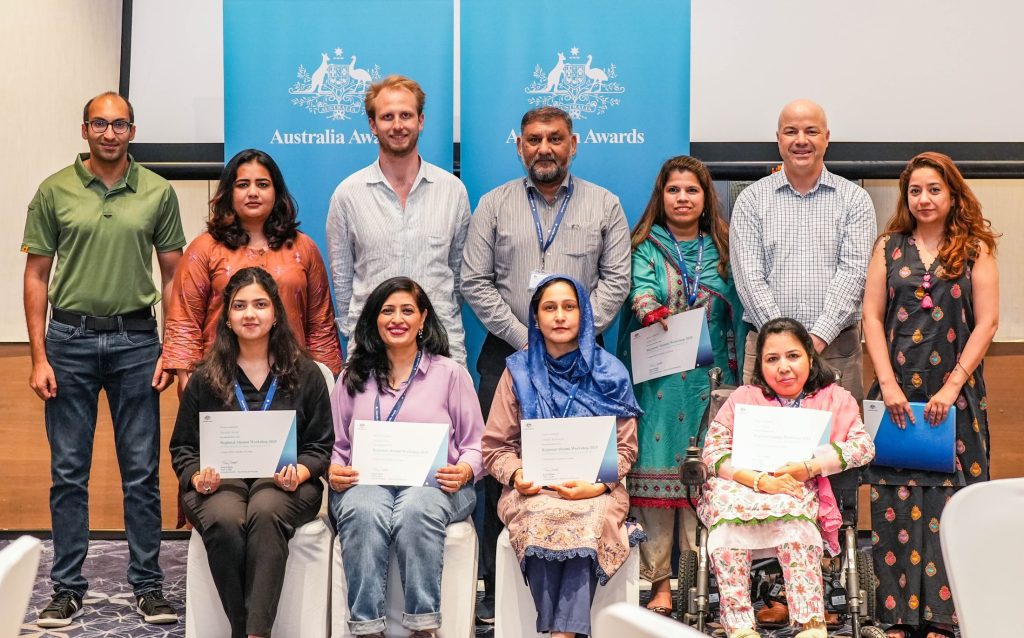
Umme (front row, second from right) after receiving her certificate of participation at the 2025 Regional Alumni Workshop in Colombo, themed ‘From Inclusion to Equity: Development for All’.
Back in Pakistan, I supported the development of the Women Empowerment Policy 2026–2030 for UN Women, engaging six government departments through an intersectional lens that I could not have articulated with such precision before my studies. I conducted a Gender, Age, Disability and Inclusion analysis across eight locations for the Foundation for Ageing and Inclusive Development, producing not just a report but a full strategy, action plan and monitoring framework. I designed gender-responsive guidelines for disaster preparedness in Chitral for the Aga Khan Foundation. I mapped all life skills education initiatives across an entire province for Aahung to inform the development of minimum education standards. I evaluated a heatwave anticipatory action program for the Start Network using the mixed-methods and intersectional frameworks I had studied in Melbourne.
Each of these assignments carries a direct line back to what I learnt in Australia.
But perhaps the impact I value most is less visible in any report or deliverable. Before my Australia Awards experience, I was a strong practitioner. After it, I became someone who could sit in a room with a government minister, a United Nations director and a community elder, and translate between their worlds. The Scholarship did not just give me a degree. It gave me the confidence and the conceptual vocabulary to position gender equality not as a programmatic add-on, but as a governance imperative.
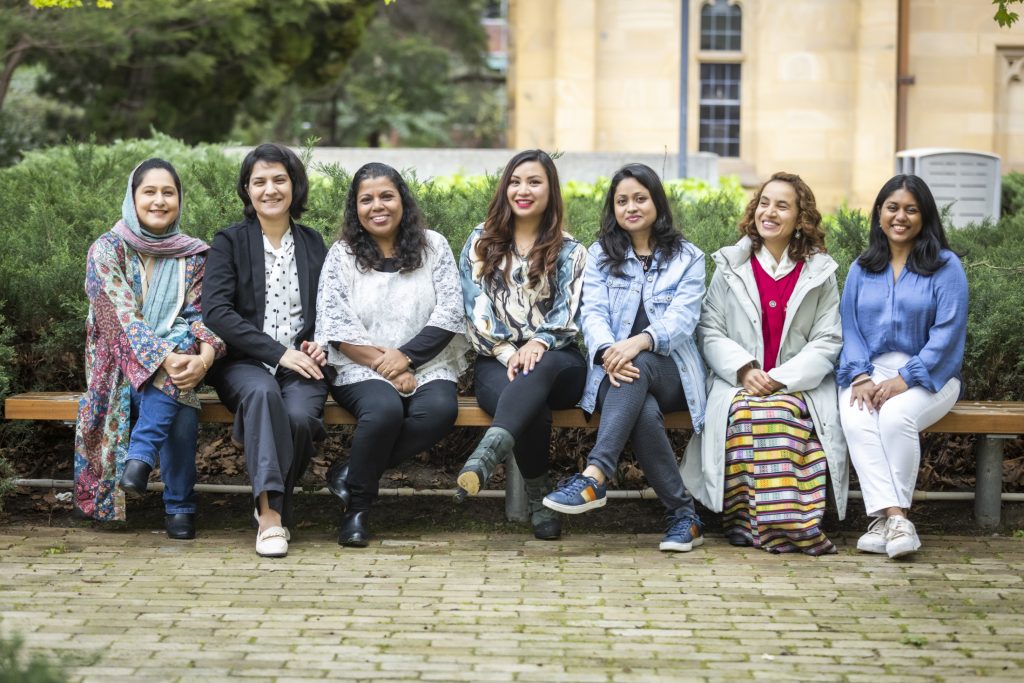
Umme (left) with fellow female scholars from South Asia and Mongolia in Melbourne during her Scholarship experience in Australia.
That shift, from implementer to strategic adviser, has multiplied my impact in ways that no single project could.
Seventy-five years ago, the first Colombo Plan scholars travelled to Australia. I am proud to be part of that legacy, and even prouder that the investment Australia made in my education continues to generate returns across Pakistan, the Western Balkans and wherever the work takes me next.