Pakistani scholars gain knowledge at Scholars Symposiums to drive innovation and resilience
Posted: 17 December 2025
From October to December, 12 Pakistani Australia Awards scholars participated in five Scholars Symposiums across Australia. These events, which had the theme of From Learning to Leading: Make an Impact, were designed to help scholars develop the skills they need to be changemakers after completing their Scholarships.
Each symposium began with an address from a representative of the Australian Department of Foreign Affairs and Trade (DFAT). Speaking at the Canberra Symposium, Lucienne Manton, the Assistant Secretary of DFAT’s Mainland South and Central Asia Branch, said, “The granting of an Australia Award marks a recognition of potential. We are pleased to support activities like this Symposium as one way to help you build on that potential and become changemakers for sustainable development—truly taking the step from learning to leading.”
Delivering opening remarks in Canberra on behalf of the scholar cohort, Pakistani scholar Shamsa Yousaf said, “We are not just scholars; we are changemakers in the making, each carrying the torch of knowledge to light the path of progress back home. Over the next two days, let us reflect on how we can turn our learning into action, lead with courage and humility, and use the knowledge we gain here to strengthen our communities and drive innovation and resilience.”
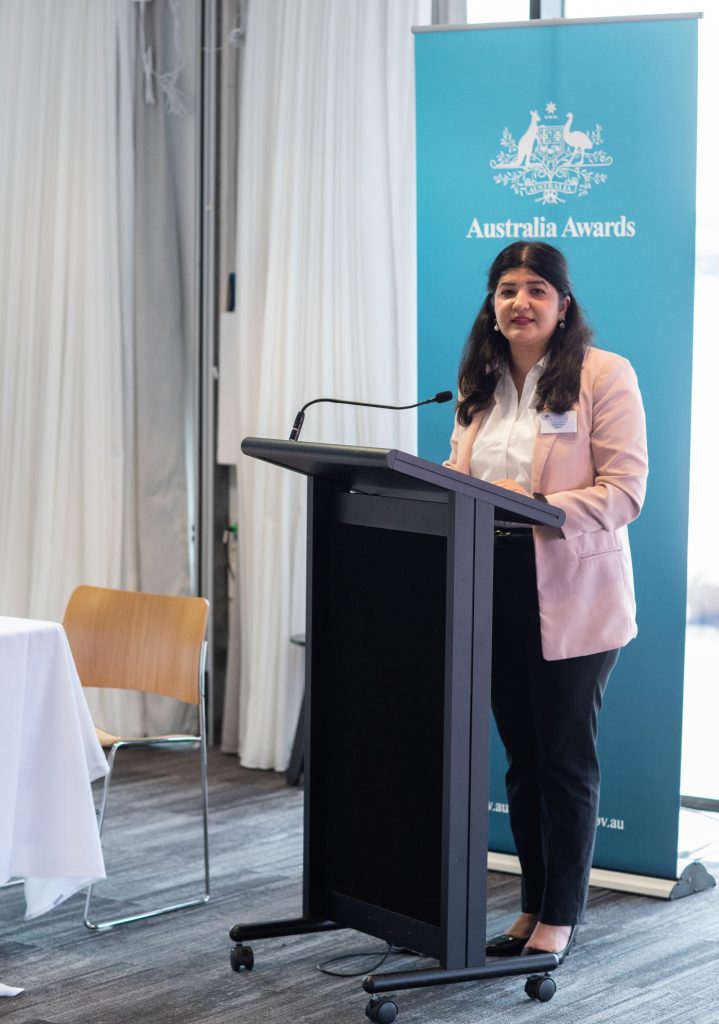
Shamsa delivering opening remarks in Canberra.
A highlight of each symposium was a panel of expert speakers drawn from the Australian Government, the diplomatic or consular corps, and the development sector. Panel members spoke about a variety of subjects relating to leadership, including the importance of values for leaders, their tips for networking and advice on advocating for change. These speakers included:
- Senator Charlotte Walker, the youngest person elected to Australia’s Senate, in Adelaide
- Katie Smith, the Director of DFAT’s South Asia and Mongolia Section, in Canberra
- Qamar Zaman, the Consul General of Pakistan, in Sydney
- Saadia Adnan, a PhD candidate at the University of Adelaide and an Australia Awards alumna herself, in Adelaide.
The panels were facilitated by a scholar at each event, with Pakistani scholar Wirdah Khaif moderating the session in Melbourne. “The panel discussion with leaders and experts offered rich leadership lessons,” Wirdah said.
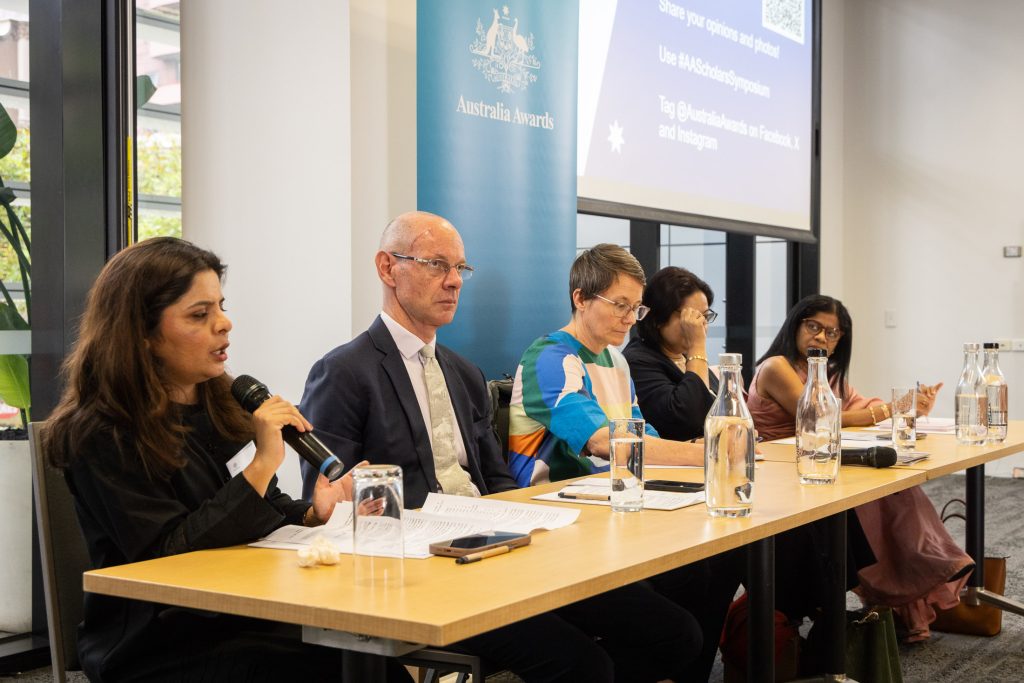
Wirdah Khaif facilitating the panel discussion during the Melbourne Symposium.
The afternoon of the first day of each symposium was dedicated to leadership or communications training, designed to assist scholars to put into action what they had heard during the opening remarks and panel discussion in the morning.
Reflecting on this training in Canberra, Pakistani scholar Muhammad Naeem Orakzai said, “Listening to the panellists and [the facilitator] Peter gave me useful information through experiences and [a] structured lecture on leadership.”
The second day of the symposiums saw scholars consider their Development Impact and Linkages Plans (DILPs) and whether they needed to update them in light of their time in Australia and what they had learnt on the first day of the symposiums. Adelaide-based Pakistani scholar Muhammad Haris said, “A deep understanding of leadership and a review of our DILP was really helpful for both personal and professional development.”
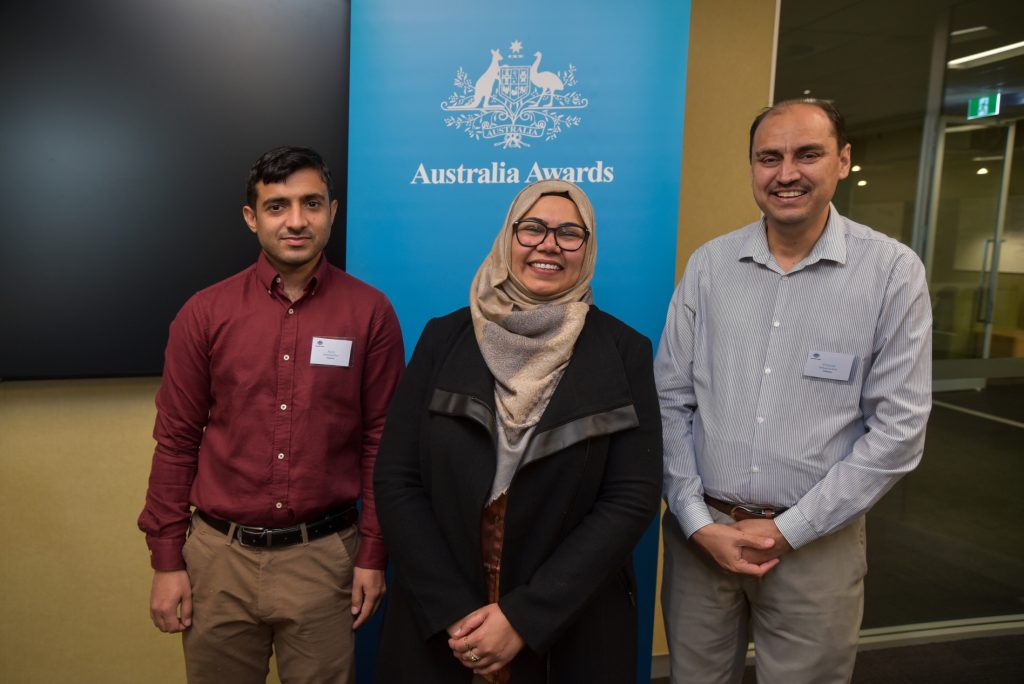
Pakistani scholars Muhammad Haris (left) and Shahzad Ali Khan (right) with alumna and panel member Saadia Adnan (centre) in Adelaide.
Scholars also had the opportunity to provide their peers with an overview of their DILP and outline how their studies and professional development activities in Australia had helped them to implement their plans. In Adelaide, Pakistani scholar Shahzad Ali Khan shared what he had done to build complementary skills and professional experience as he completed his Master of Engineering (Water Resource Management) at the University of South Australia.
To finish the symposiums, scholars engaged in cultural activities with First Nations Australians. These activities included having an art lesson from Indigenous teachers in Brisbane, Melbourne and Sydney; viewing Indigenous art in galleries in Canberra and Adelaide; and learning to throw a boomerang in Brisbane. Reflecting on her experience in Melbourne, Pakistani scholar Sajal Tariq said, “Engaging with the Indigenous artist [Rhys Jeffs] helped me reimagine the meaning of my calm and peace.”
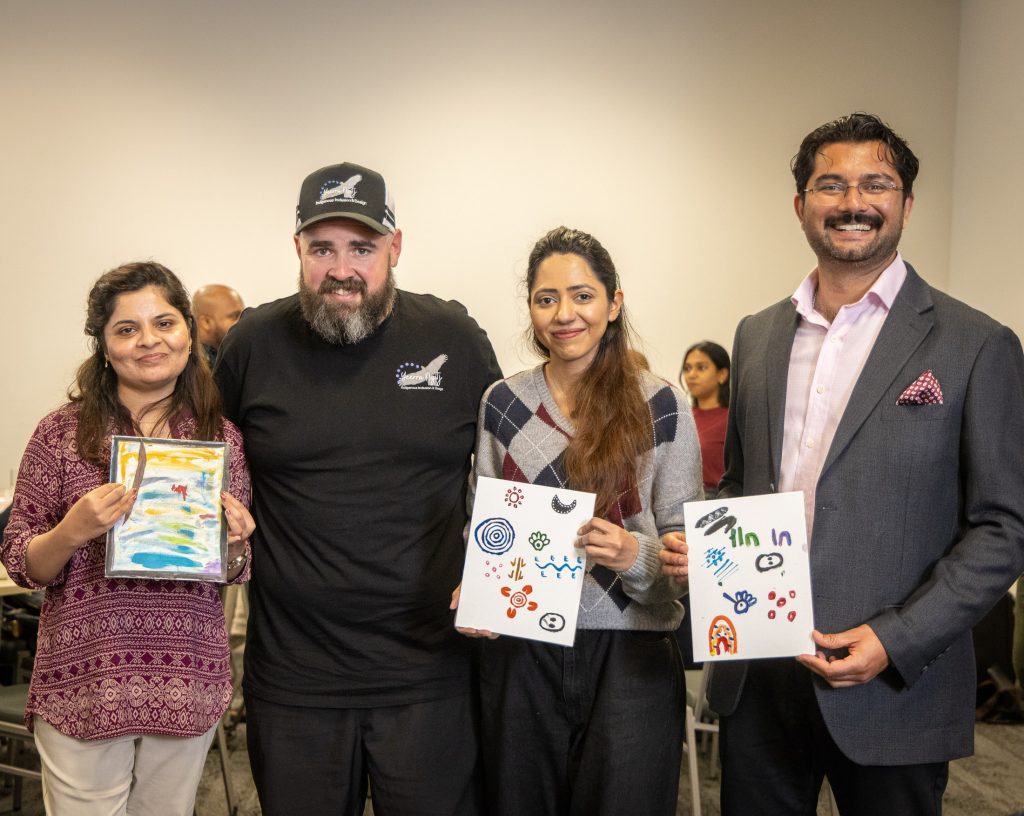
Pakistani scholars (from left to right) Wirdah Khaif, Sajal Tariq, and Nowsherwan Ali with Indigenous artist Rhys Jeffs (second from left) in Melbourne.
For many scholars, the most valuable aspect of the events was the opportunity to network with other scholars from across South Asia and Mongolia.
“I loved the energy of participants,” said Canberra-based Pakistani scholar Zoha Shakir. “I enjoyed the intellectual discourse and learnt a lot from the perspective of panellists and fellow scholars.”
Summing up the views of many participants, Sydney-based Pakistani scholar Usama Jadoon said, “This Symposium gave me [a] great opportunity to reflect on my career, life goals and communication skills.”